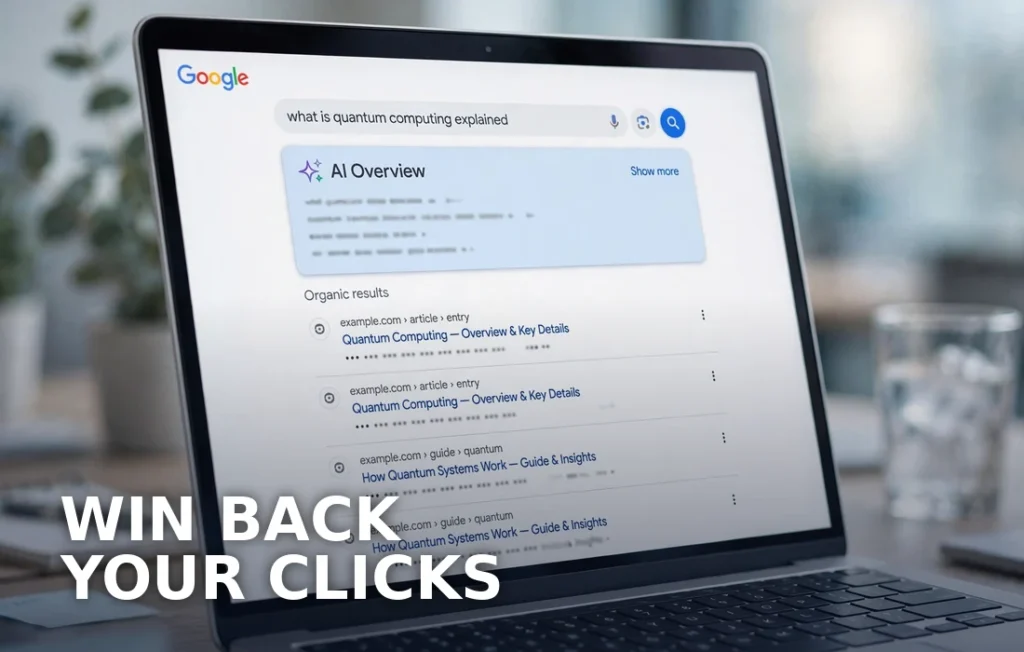
Short answer: SEO in 2026 still works — but the playbook changed. AI Overviews now answer simple queries directly, so winning strategies focus on original research, first-hand experience, topical authority, and technical excellence. Keyword stuffing, thin content, and mass-produced AI articles are dead.
Key Takeaways
- AI Overviews reduced clicks for simple informational queries — but commercial and complex queries still drive massive traffic.
- Google’s E-E-A-T (Experience, Expertise, Authoritativeness, Trustworthiness) matters more than ever.
- Original data, real experience, and unique perspectives are the new ranking currency.
- Technical SEO (Core Web Vitals, structured data, crawlability) remains the non-negotiable foundation.
- Brand searches and topical authority increasingly determine who gets cited — by Google and by AI assistants.
How AI Changed Search (And What It Means for You)
Google’s AI Overviews — and AI assistants like ChatGPT, Gemini, and Perplexity — now answer straightforward questions without a click. Queries like “what is the capital of France” no longer send traffic to anyone. But this shift mostly killed commodity content. For queries with commercial intent (“best CRM for small business”), local intent (“dentist near me”), or genuine complexity, users still click through — and often with higher intent than before.
What Still Works in 2026
1. E-E-A-T and First-Hand Experience
Google’s helpful content guidance explicitly rewards content demonstrating first-hand experience. In an era of infinite AI-generated text, “we actually did this and here’s what happened” is a genuine competitive moat. Case studies, original experiments, and practitioner-written guides outperform generic explainers.
2. Topical Authority Over Isolated Keywords
Ranking one page is harder; owning a topic is the strategy. Sites that publish comprehensive, interlinked coverage of a subject area — pillar pages supported by detailed cluster content — consistently outperform sites chasing individual keywords. This is exactly why we built this blog as a topic hub for each of our SEO services.
3. Original Research and Data
AI models and journalists both cite original data. Surveys, industry benchmarks, and proprietary studies earn the backlinks and brand mentions that algorithms reward. One solid research piece can outperform fifty generic listicles — and it’s nearly impossible for competitors to replicate.
4. Technical SEO Fundamentals
None of the glamorous stuff works on a broken foundation. In 2026 the technical checklist is: Core Web Vitals in the green, clean crawlable architecture, proper structured data (Article, FAQ, HowTo), accurate sitemaps, and no indexation blockers.
5. Digital PR and Brand Mentions
As AI assistants answer from training data and live sources, being mentioned matters as much as being linked. Digital PR — expert commentary, data stories, podcast appearances — builds the brand signals that both Google and LLMs use to judge authority.
6. Search Everywhere Optimization
“SEO” now means optimizing for Google, YouTube, TikTok, Reddit, and AI assistants simultaneously. Users start searches in all these places. A presence strategy across platforms compounds: YouTube videos rank in Google, Reddit threads get cited by AI answers.
What’s Dead (Stop Doing This)
- Mass AI-generated content farms — publishing hundreds of thin AI articles. Google’s spam policies explicitly target scaled content abuse.
- Keyword stuffing and exact-match obsession — semantic search understood synonyms a decade ago.
- Chasing vanity keywords — ranking #1 for a term nobody clicks is worthless in the AI Overview era.
- Ignoring search intent — if your page doesn’t match what the searcher actually wants, nothing else matters.
- Buying links — Google’s spam policies on link schemes are enforced more aggressively than ever.
How to Measure SEO Success in 2026
Stop obsessing over individual keyword positions. The metrics that matter now: organic conversions and revenue, branded search volume growth, share of voice across your topic, citations in AI answers, and assisted conversions. Rankings are a means; pipeline is the end.
FAQ
Is SEO dead because of AI?
No. AI changed which queries send clicks, but search volume keeps growing and commercial-intent traffic still converts. SEO evolved — it didn’t die. Businesses that adapt to E-E-A-T and topical authority are thriving.
How long does SEO take to show results in 2026?
Typically 4–6 months for meaningful movement on competitive terms, though technical fixes can lift traffic in weeks. Anyone promising page-one rankings in 30 days is selling something you don’t want.
Should I optimize for ChatGPT and AI assistants too?
Yes — this is called GEO (generative engine optimization). The good news: the same things work — clear factual content, original data, strong brand mentions, and structured formatting. Optimize once, benefit everywhere.
Do backlinks still matter?
Absolutely. Google has repeatedly confirmed links remain a core ranking signal. What changed is that quality thresholds rose sharply — one authoritative editorial link beats a hundred directory links. See our backlink building services for how we earn them.
The Bottom Line
SEO in 2026 rewards what it always should have: genuine expertise, original value, and technical excellence. The shortcuts are gone — which is great news for businesses willing to do it right. Explore our SEO services or request a free SEO audit to see where you stand.