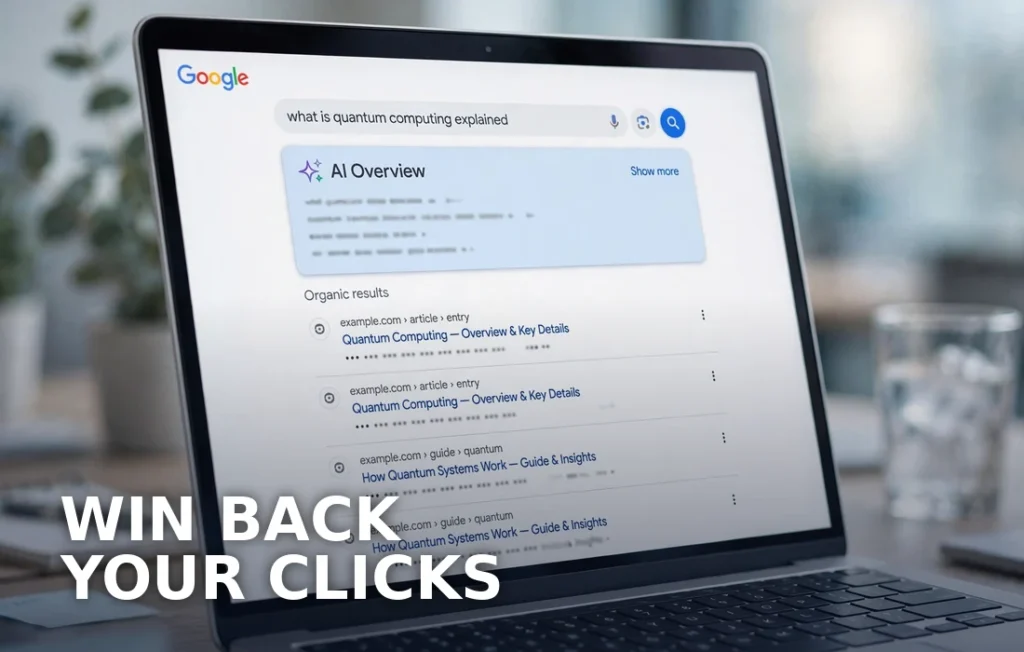
Your traffic didn’t drop because your SEO got worse. It dropped because Google started answering the question itself.
AI Overviews now sit on top of results for informational queries, summarizing answers from multiple sites. The user gets what they need without clicking anything. Studies keep showing the same pattern: when an AI Overview appears, click-through rates on organic results fall hard.
You cannot opt out of this. But you can adapt. Here are 9 ways that actually work.
1. Target queries AI Overviews handle badly
AI Overviews are weakest on questions needing judgment, current data, or local context: comparisons, “best X for Y” with trade-offs, pricing breakdowns, and anything opinionated. Write for those. “Best CRM for a 10-person agency” beats “what is a CRM” every time now.
2. Structure content so AI quotes you
Overviews cite sources. Pages with clear definitions, direct answers in the first 100 words, comparison tables, and numbered steps get cited far more often. A citation is not a click, but it builds the brand familiarity that earns the click later.
3. Win branded and “best” searches
When someone searches your brand name or “best [service] in [city]”, AI Overviews appear less often and intent is commercial. These are your highest-value clicks. Make sure your brand SERP is fully owned: website, profiles, reviews.
4. Double down on bottom-of-funnel content
Top-of-funnel informational traffic is what AI Overviews eat. Pricing pages, case studies, comparison pages, and “hire X” queries still convert and still get clicked. Shift 50% of new content toward commercial intent.
5. Build topical authority, not random posts
Google’s AI pulls from sources it trusts on a topic. Ten connected articles on one subject beat ten scattered ones. Pick your money topics and cover them in clusters with strong internal linking.
6. Get cited: original data and quotes
AI models favor content with original research, statistics, screenshots, and expert quotes. One original survey or data study earns more citations than twenty rewritten listicles. Publish something only you could write.
7. Optimize for Bing and ChatGPT too
A growing share of discovery now happens in ChatGPT, Perplexity, and Bing Copilot. They cite web sources with links. The same structured, factual content that wins AI Overview citations wins there too. Check where your brand appears in AI answers monthly.
8. Turn readers into subscribers
If Google won’t send every visitor, keep the ones you get. Email capture on every high-traffic post, a useful lead magnet, and a short welcome sequence turn one-time readers into repeat traffic you own.
9. Measure what matters now
Stop reporting raw sessions as the headline metric. Track: branded search volume, AI Overview citation rate, email signups per post, and assisted conversions. The traffic mix changed; your dashboard should too.
What to do this week
Pick your 5 highest-traffic informational posts. Add a direct-answer paragraph at the top, a comparison table, and an email capture box. Then write one bottom-of-funnel post for your main service. That is the entire playbook for week one.
The bottom line
AI Overviews didn’t kill SEO. They killed lazy informational content. Specific, structured, opinionated content with real data still wins clicks, citations, and customers. The bar moved up. Meet it.
Need help adapting your SEO for the AI-search era? Our SEO services are built for exactly this shift.