
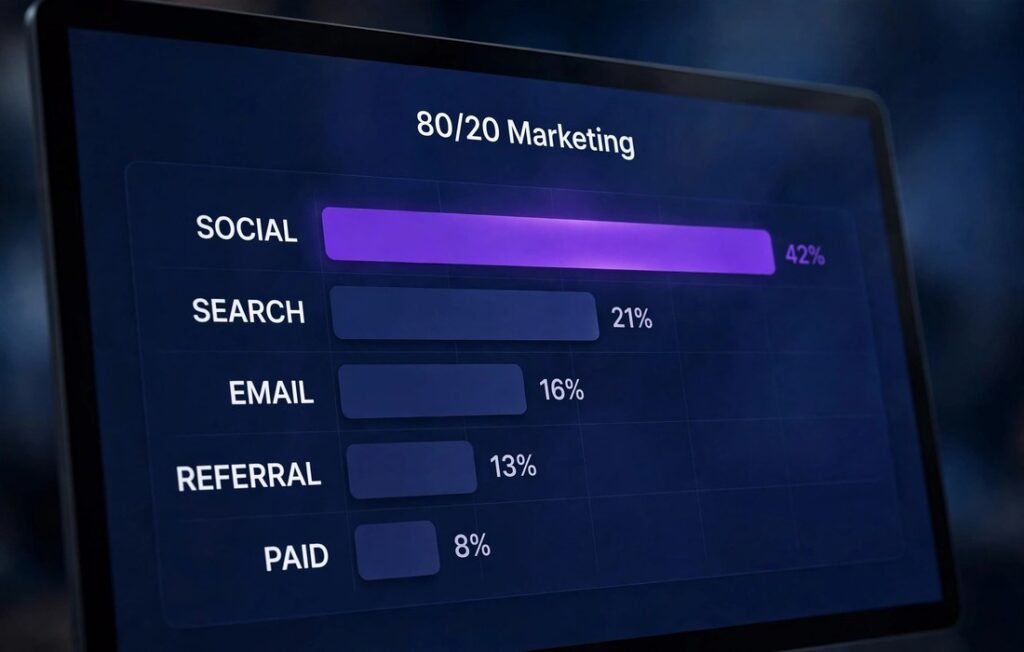
Short answer: For most small businesses in 2026, the highest-ROI channels are: (1) SEO and content marketing, (2) Google Ads for high-intent keywords, (3) email marketing to your own list, and (4) one social platform where your customers actually are. Everything else is optional until these four are working.
Key Takeaways
- Email marketing still delivers the highest average ROI — commonly cited around $36–$42 per $1 spent.
- SEO compounds: unlike ads, content keeps generating traffic long after you stop paying.
- Most small businesses fail by spreading thin across 6 channels instead of dominating 2–3.
- Track revenue per channel, not vanity metrics like followers or impressions.
- Your website’s conversion rate multiplies the ROI of every channel — fix it first.
The 80/20 Rule Applied to Marketing
Vilfredo Pareto’s principle holds brutally true in marketing: roughly 80% of your results come from 20% of your activities. Yet most small businesses do the opposite — a little SEO, occasional social posts, a neglected email list, sporadic ads — and wonder why nothing moves. The fix isn’t more effort; it’s concentrated effort on the channels with proven returns.
The 4 Channels Worth Your Budget
1. SEO & Content Marketing — The Compounder
SEO is the only channel where results appreciate over time. A blog post ranking #1 can generate leads for years with zero marginal cost. Yes, it takes 4–6 months to gain traction — which is exactly why most competitors quit, leaving the field open. Businesses that commit to strategic SEO build a durable acquisition asset no algorithm change can repossess.
2. Google Ads (Search) — The Accelerator
For high-intent keywords (“emergency plumber chicago”, “buy CRM software”), nothing beats search ads for immediate revenue. The key discipline: only bid on keywords with proven commercial intent, track cost-per-acquisition religiously, and send traffic to dedicated landing pages — never your homepage. Done right, Google Ads is a money-printing machine; done carelessly, it’s a money shredder.
3. Email Marketing — The Profit Center
Your email list is the only audience you truly own — no algorithm between you and the customer. Industry benchmarks consistently place email ROI around $36+ per dollar spent, the highest of any channel. The playbook: lead magnet → welcome sequence → weekly value emails → segmented promotions. Start building the list on day one, even before you need it.
4. One Social Platform — Done Properly
Pick the ONE platform where your buyers spend time (LinkedIn for B2B, Instagram/TikTok for consumer, YouTube for education-heavy products) and commit to it fully. A single thriving channel beats five dead ones. Organic social is increasingly pay-to-play for reach, so treat it as a brand and community channel, with paid social as a targeted amplifier.
Channels to Deprioritize (For Now)
- Display ads — cheap clicks, terrible intent. Useful for retargeting only.
- Being on every social network — dilution kills. Master one first.
- Viral-chasing content — entertainment metrics don’t pay invoices.
- Expensive brand campaigns — you’re not Coca-Cola; every dollar must be accountable.
The Multiplier Everyone Ignores: Conversion Rate
Here’s the math nobody does: doubling your website’s conversion rate from 1% to 2% doubles the ROI of every channel simultaneously — SEO, ads, email, all of it. Before increasing ad spend, fix the fundamentals: clear value proposition above the fold, fast load times, social proof, and frictionless forms. Our UX design principles guide covers exactly how.
A Simple Prioritization Framework
- Month 1–2: Fix website conversion basics, set up analytics properly, start email capture.
- Month 2–3: Launch Google Ads on proven high-intent keywords for immediate cash flow.
- Month 3+: Begin SEO/content engine — it compounds while ads pay the bills.
- Ongoing: Build one social channel; reinvest profits into what’s measurably working.
- Always: Weekly email to your list. It’s nearly free and consistently converts.
For deeper channel tactics, see HubSpot’s regularly updated marketing statistics to benchmark your numbers.
FAQ
What’s the best marketing channel for a brand-new business?
Google Ads for immediate leads plus email capture from day one. SEO starts compounding in the background. Don’t wait for “perfect” — launch, measure, iterate.
How much should a small business spend on digital marketing?
A common benchmark is 7–10% of revenue for established businesses, higher when growing aggressively. More important than the percentage: every channel must clear a defined cost-per-acquisition target.
Is social media marketing worth it for B2B?
LinkedIn — yes, especially organic thought leadership plus targeted ads. TikTok dances — no. Match the channel to where your buyers make decisions.
Should I hire an agency or do it myself?
DIY works until growth stalls — usually when you need expertise across SEO, ads, and analytics simultaneously. A good agency costs less than one bad full-time hire and brings cross-industry pattern recognition. See our digital marketing services to compare.
The Bottom Line
Marketing ROI isn’t about doing more — it’s about doing less, better. Nail SEO, search ads, email, and one social channel before you touch anything else. Let our team build your 80/20 marketing engine or book a free strategy call.