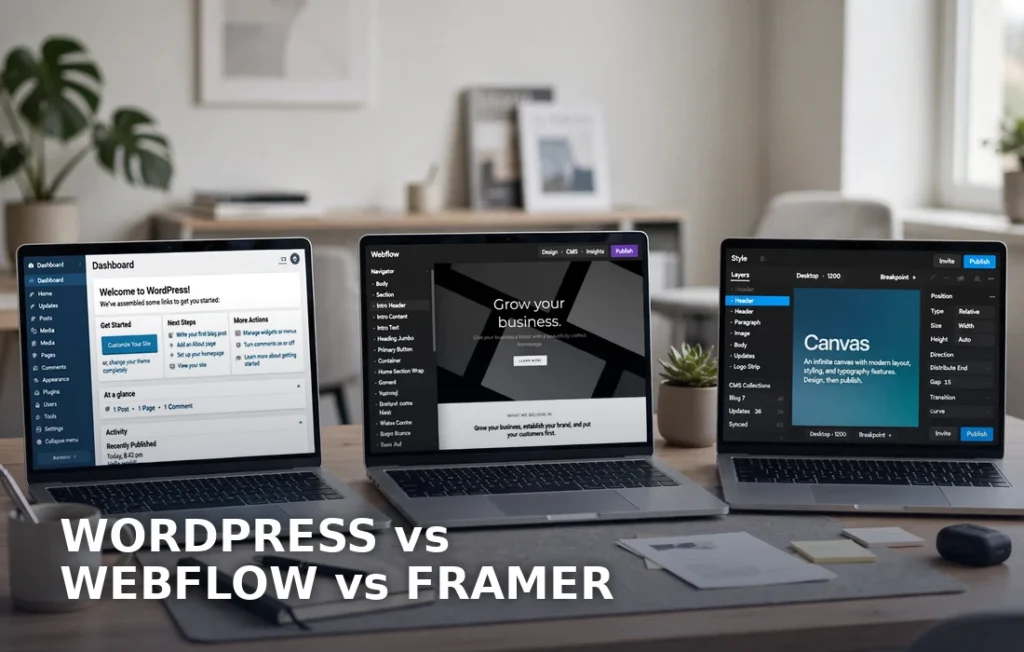
Short answer: WordPress powers over 43% of all websites because it combines zero licensing cost, unmatched flexibility, full ownership, and an ecosystem of 59,000+ plugins. For most business websites in 2026, a professionally built WordPress site delivers the best balance of cost, control, and capability.
Key Takeaways
- WordPress runs 43%+ of the web — more than all other CMS platforms combined (W3Techs).
- Zero licensing fees, full data ownership, and no vendor lock-in.
- The block editor (Gutenberg) made WordPress genuinely easy for non-technical teams to manage.
- Security and performance depend on how it’s built — professional development matters.
- Consider alternatives only for complex web apps, massive e-commerce, or ultra-specific needs.
WordPress by the Numbers
The statistics are staggering. According to W3Techs, WordPress powers over 43% of all websites — and over 60% of sites using a CMS. Its plugin directory hosts more than 59,000 free plugins, and thousands of professional themes. This isn’t legacy inertia; WordPress’s market share has grown steadily for a decade, including through the rise of website builders and headless architectures.
7 Reasons Businesses Choose WordPress in 2026
1. You Own Everything
WordPress is open-source (GPL). No monthly platform fees, no one can shut off your site, and you can move hosts or developers freely. Compare that to hosted builders where you’re renting your own website — this ownership advantage alone justifies WordPress for serious businesses.
2. Total Cost of Ownership Wins
The software is free. A professional WordPress build costs a fraction of fully custom development while delivering 90% of the capability most businesses need. Ongoing costs are just hosting and maintenance — no per-seat fees, no transaction percentages, no “pro plan” upsells for basic features.
3. The Block Editor Changed Everything
The old knock on WordPress — “hard for non-technical users” — died with the Gutenberg block editor. Modern WordPress lets your marketing team build landing pages, update content, and publish posts with an intuitive visual interface, while developers retain full code-level control underneath.
4. SEO Out of the Box (and Beyond)
WordPress’s clean permalink structure, semantic markup, and plugins like Rank Math give you technical SEO control rivaling custom builds. It’s no coincidence that WordPress dominates content-driven sites that live or die by organic search — pair it with solid SEO strategy and it’s formidable.
5. E-commerce with WooCommerce
WooCommerce — WordPress’s e-commerce plugin — powers millions of online stores with no transaction fees and unlimited products. For most SMB e-commerce, it beats Shopify on cost and flexibility (Shopify wins on pure simplicity).
6. Scales From Blog to Enterprise
WordPress runs everything from personal blogs to the sites of major publishers, universities, and Fortune 500 companies. With proper hosting, caching, and development, it handles millions of monthly visitors. The ceiling is far higher than most businesses will ever need.
7. Future-Proof Flexibility
Need a membership portal? Multilingual site? Headless front-end with React? API integrations? There’s a proven path for all of it. WordPress’s REST API even lets you use it as a headless CMS behind a custom web application — the best of both worlds.
The Honest Downsides (and How Pros Handle Them)
- Security needs attention — its popularity makes it a target. Solution: managed updates, reputable plugins only, hardened hosting, and regular backups. A professionally maintained WordPress site is very secure; a neglected one isn’t.
- Plugin bloat — installing 40 plugins slows any site. Solution: disciplined architecture — fewer, high-quality plugins and custom code where it matters.
- Not ideal for complex web apps — if you’re building the next SaaS dashboard, a custom stack fits better. WordPress is a content platform first.
WordPress vs. The Alternatives in 2026
vs. website builders (Wix/Squarespace): WordPress wins on ownership, SEO control, and scalability; builders win on absolute simplicity. See our full comparison guide.
vs. fully custom development: Custom wins for unique applications; WordPress wins on cost and time-to-market for content sites. Many projects use both — WordPress for marketing site, custom app for product.
vs. headless CMS (Contentful, Sanity): Headless wins for omnichannel publishing at enterprise scale; WordPress wins on cost, ecosystem, and ease for typical business sites.
FAQ
Is WordPress still relevant in 2026?
More than ever — its market share continues to grow, the block editor keeps improving, and its ecosystem is unmatched. Reports of its death have been greatly exaggerated for 15 years running.
Is WordPress secure enough for business?
Yes, when professionally built and maintained. Core WordPress is very secure; vulnerabilities overwhelmingly come from neglected updates and nulled/pirated plugins — both avoidable with proper WordPress development and maintenance.
How much does a professional WordPress site cost?
A quality custom WordPress site typically ranges from a few thousand dollars for a marketing site to much more for complex builds — still a fraction of fully custom development, with no ongoing licensing fees.
Can WordPress handle e-commerce?
Absolutely. WooCommerce powers a huge share of online stores worldwide, with no transaction fees and complete design freedom.
The Bottom Line
For most businesses, WordPress remains the rational choice: proven at massive scale, free of lock-in, and flexible enough for nearly anything. The key is professional implementation — a well-built WordPress site is an asset; a sloppy one is a liability. Explore our WordPress development services or discuss your project.