
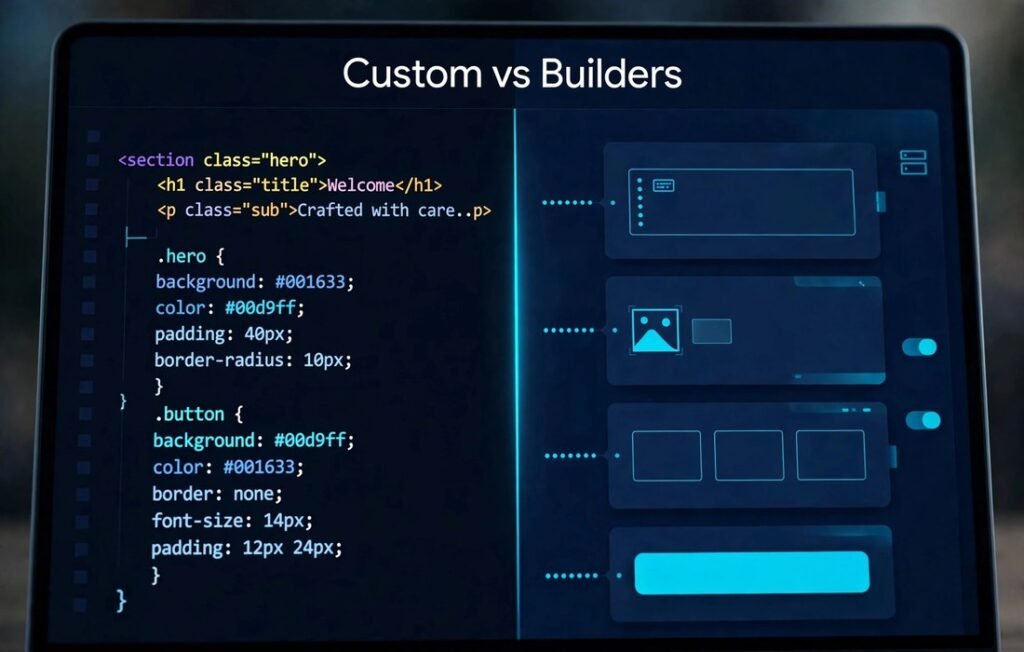
Short answer: Website builders like Wix and Squarespace are best for simple sites you need live this week on a tight budget. Custom web development is best for businesses that need unique functionality, serious SEO performance, and room to scale. For most growing businesses, custom development wins on total cost of ownership within 2–3 years.
Key Takeaways
- Website builders: fast and cheap upfront ($15–$50/month), but limited customization, weaker technical SEO control, and you never truly own the platform.
- Custom development: higher upfront investment, but full ownership, better performance, and unlimited scalability.
- Businesses planning to grow usually outgrow builders within 18–24 months — and migrating later costs more than building right the first time.
- Hybrid option: start on WordPress (open-source) for a balance of speed, cost, and ownership.
What Is Custom Web Development?
Custom web development means your website or web application is designed and coded specifically for your business — typically with modern frameworks like React, Next.js, or a tailored WordPress build. Every pixel, every interaction, and every line of code exists to serve your goals. There are no template constraints and no platform rules to work around.
This is the approach agencies like Smartwisers’ web and mobile development team take for clients who need more than a digital brochure.
What Are Website Builders?
Website builders (Wix, Squarespace, Weebly, Shopify for e-commerce) are hosted platforms with drag-and-drop editors and pre-made templates. You pay a monthly subscription, pick a template, add your content, and you’re live — often the same day. The trade-off: you operate inside their walled garden.
Head-to-Head Comparison
1. Cost
Builders win on day one: $15–$50/month gets you hosting, templates, and support. Custom development typically starts in the low thousands for a professional build. But run the numbers over three years: builder subscriptions, paid plugins, and transaction fees add up — and if you outgrow the platform, you pay for a full rebuild anyway. Custom sites have near-zero marginal platform cost after launch.
2. Time to Launch
Builders: days. Custom: typically 4–12 weeks depending on complexity. If speed is the only criterion, builders win — but a rushed site that can’t convert is the most expensive kind of cheap.
3. Customization and Unique Functionality
This is where builders hit a wall. Need a custom booking flow, a client portal, advanced filtering, or integration with your internal systems? Builders offer apps and plugins, but anything truly unique requires workarounds — or is simply impossible. Custom development has no ceiling: if you can describe it, it can be built.
4. SEO and Performance
Technical SEO is one area where the gap is widest. Custom builds let you control everything Google cares about: Core Web Vitals, semantic HTML, structured data, URL architecture, and server response times. Builders have improved, but you can’t fix what you can’t access — and bloated builder code routinely produces slower pages. Google’s own documentation on Core Web Vitals makes clear that performance directly affects rankings.
5. Scalability
A builder site that works for 1,000 visitors a month may crawl at 100,000. Custom architectures are designed for your growth trajectory from day one — with proper caching, CDNs, and database design. According to W3Techs, the web’s largest sites overwhelmingly run on custom or open-source stacks, not closed builders.
6. Ownership and Portability
With a builder, you’re renting. Stop paying, and your site disappears — you generally can’t export it and move elsewhere. A custom site (or open-source WordPress site) is yours: move hosts freely, hire any developer, and never face platform lock-in.
When Should You Choose a Website Builder?
- You need a simple informational site live within days.
- Your budget is under $1,000 and won’t grow soon.
- You have no custom functionality requirements and don’t expect any.
- It’s a short-term project (event page, MVP test, portfolio).
When Is Custom Development the Right Call?
- Your website is a revenue driver, not a brochure.
- You need custom features, integrations, or user accounts.
- SEO is a core acquisition channel — you need full technical control.
- You plan to scale traffic, products, or markets.
- Brand differentiation matters — you can’t look like 10,000 template clones.
The Hidden Costs of Website Builders
Few businesses calculate the real price of “cheap”: monthly fees that rise every renewal, paid apps for basic features (forms, popups, multilingual), transaction fees on sales, and the eventual migration when you hit the platform’s limits. Add the opportunity cost of a slow, generic site that converts poorly, and the “affordable” option starts looking expensive.
FAQ
Is custom web development worth it for a small business?
Yes, if your website generates leads or sales. A custom site typically pays for itself through better conversion rates and SEO performance. For a purely informational site with no growth plans, a builder may suffice.
Can I migrate from Wix to a custom site later?
Yes, but it’s a full rebuild — content must be manually moved and URLs redirected to preserve SEO. It’s almost always cheaper to build custom from the start if you expect to grow.
What about WordPress — is it a builder or custom?
WordPress is open-source software, not a hosted builder. A professionally developed WordPress site gives you builder-like ease of content management with custom-level control and full ownership. It’s the most popular middle path.
How long does custom web development take?
A professional marketing site typically takes 4–8 weeks; complex web applications take 3–6 months. Timelines depend on scope, feedback speed, and content readiness.
The Bottom Line
Website builders rent you a presence; custom development builds you an asset. If your business is going somewhere, build the vehicle that can get you there. Talk to our web development team for a free consultation on which path fits your goals — or get in touch to discuss your project.